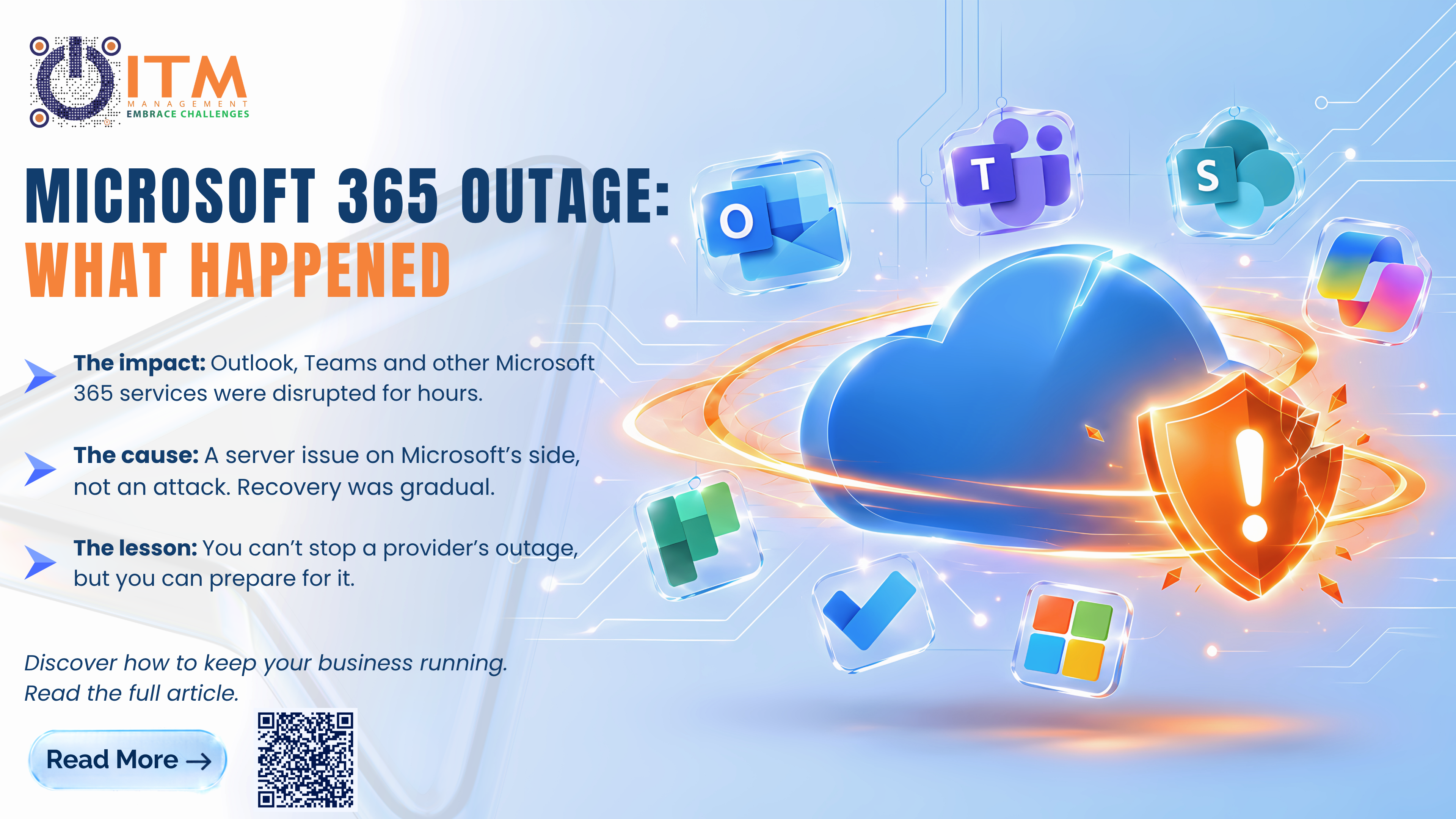

On Thursday, 12 November, thousands of businesses discovered how much of their day depends on a single cloud service. A Microsoft 365 outage disrupted Outlook, Teams and other Microsoft applications for hours, leaving employees unable to send emails, join meetings or reach colleagues.
The event is a useful reminder: cloud services are reliable, but not infallible, and the businesses that cope best are those that planned for the bad day in advance.
What happened
According to Reuters, the disruption affected Microsoft 365, Outlook, Teams and other company apps, and lasted more than five hours. Microsoft said several of its servers became unexpectedly unavailable under elevated load, and that this was not caused by a spike in traffic. It added that recovery would be gradual as capacity was restored and users’ clients reconnected.
Forbes reported that the affected services potentially included Exchange Online, Teams, SharePoint Online, Microsoft Copilot and Microsoft Defender XDR. At its peak, Downdetector recorded more than 138,000 problem reports for Outlook. The impact went beyond inboxes: one US company postponed its earnings release because of the disruption.
At the time of writing, Microsoft was still working on full restoration, so details may change as more information is published.
Why one outage can slow down a whole company
For many organizations, Microsoft 365 is no longer just email. It is where meetings happen, files are stored, approvals are sent and customers are answered. When one platform carries all of this, a single failure spreads across many parts of the business at once:
- Communication stops. Email and chat are often the only channels teams use to reach each other and their customers.
- Files become unreachable. Documents in cloud storage can’t be opened or shared when they are needed.
- Security tools may be affected. If monitoring and protection also depend on the same platform, visibility can be reduced at the worst moment.
- Deadlines are at risk. Time-sensitive work, such as contracts, financial reports or customer commitments, can slip.
None of this is a criticism of cloud services. It is a reminder that concentration creates risk: the more things depend on one provider, the more it matters to have a plan.
An outage is not a cyberattack, but the response is similar
Thursday’s incident was caused by a server issue, not by an attacker. Yet for the business affected, the questions are the same as in a security incident: how do we keep working, how do we communicate, and how quickly can we recover?
That is why business continuity planning matters. It prepares the company for any event that makes a key system unavailable, whether the cause is a provider failure, a configuration error, a network problem or an attack.
Five practical steps to prepare
List the tools your business relies on every day and note which ones depend on the same provider. Many companies are surprised by how much sits behind a single login.
If email and chat go down, how will your team reach each other? A simple fallback, such as a phone group or an alternative messaging tool, with an up-to-date contact list can save hours of confusion.
A provider’s availability and your own backup are two different things. Critical data should be backed up in a way that does not rely on one service alone, and the restore process should be tested, not just assumed to work.
During an outage, delays often come from uncertainty rather than technology. Decide in advance who confirms the problem, who informs staff and customers, and who contacts the IT provider.
A plan that has never been tested usually fails in the first real situation. A short exercise once or twice a year helps the team know exactly what to do.
Keep communication simple during an incident
A calm, clear message helps staff far more than silence. A good internal update says what is affected, whether the problem is on the provider’s side, what employees should do in the meantime and when the next update will come. The same applies to customers: if your response times may be slower, tell them early.
How ITM can help
At ITM, we work with companies on the parts of IT that keep a business running when something goes wrong: infrastructure assessment, backup and recovery, disaster recovery planning, monitoring and security.
A good starting point is an IT infrastructure assessment, which shows where your business depends on a single point of failure, how well your data is protected and what to improve first. Our IT Audit is currently available at 30% off.
Outages like this will happen again, to Microsoft or to any other provider. The question for your business is not whether it can avoid them, but how prepared it will be.
Contact the ITM team to review how your business would cope if its key tools went offline tomorrow.