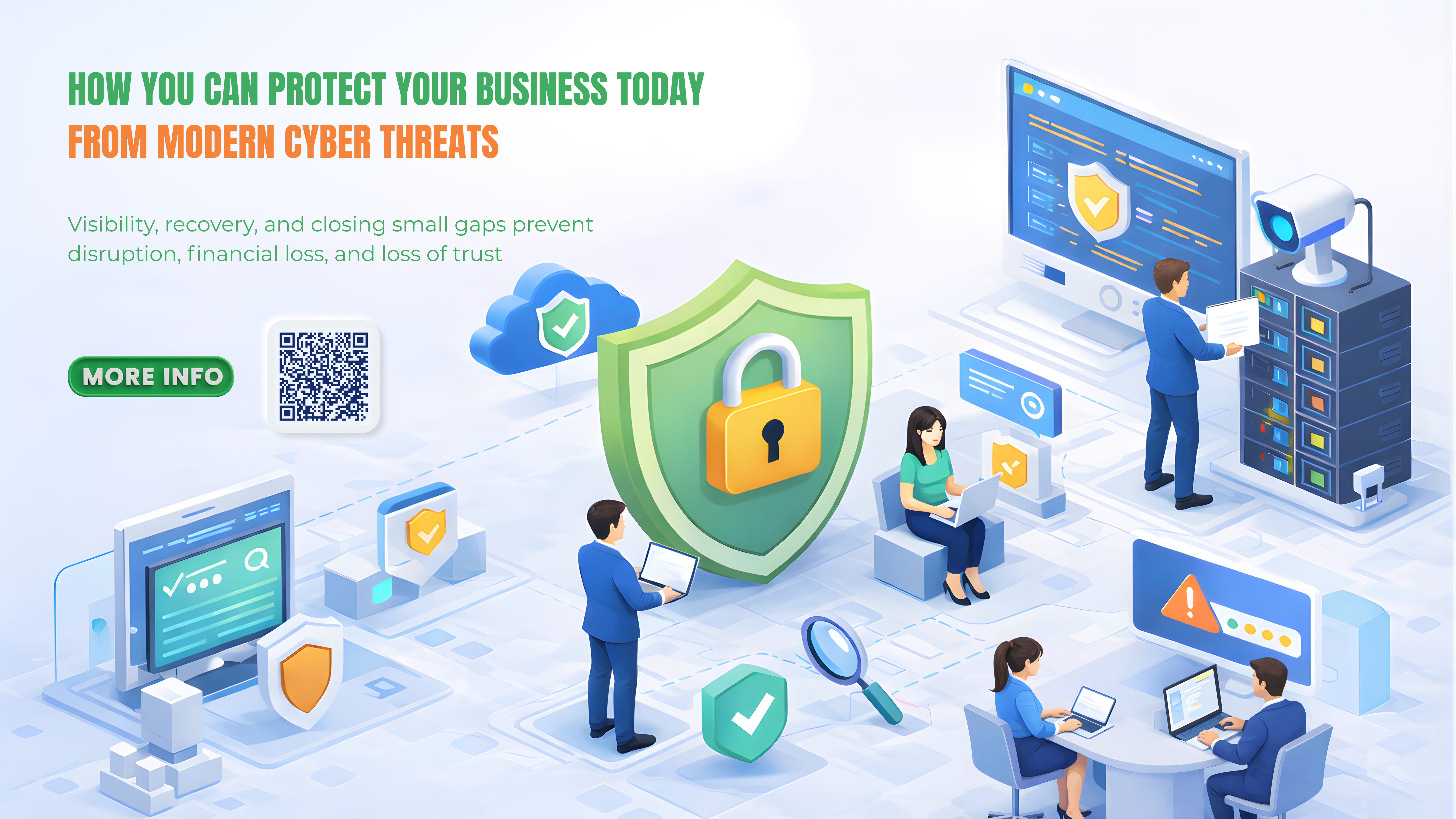

Cyber Threats Are No Longer a Future Risk
Modern cyber threats are no longer distant possibilities or rare events. They are active, persistent, and embedded in everyday business operations. Emails, cloud platforms, collaboration tools, mobile devices, and remote access have become essential to how organizations work and the same channels are now routinely exploited by attackers.
What makes modern cyber threats especially dangerous is not only their technical sophistication, but their ability to blend into normal business activity. Systems continue to operate. Employees remain productive. There are no visible alerts. Yet risk accumulates quietly until a single incident expose how vulnerable the organization truly is.
Protecting your business today starts with recognizing that cybersecurity is no longer an IT problem to be addressed later. It is a business decision that must be acted on now.
Why Cybersecurity Must Start with a Clear Technical Baseline
Cybersecurity relies on strong foundational controls network protection, endpoint security, and access management but those controls are only effective when paired with disciplined behavior and preparedness.
Many organizations delay meaningful cybersecurity action because nothing appears broken. Operations run smoothly, data remains accessible, and previous incidents may have been minor or contained. This sense of normalcy often leads to false confidence.
Modern cyber threats thrive in this gap between assumption and reality. Phishing attacks, credential theft, ransomware, and insider mistakes do not require system failures to succeed. They rely on trust, urgency, and routine behavior. Without a clear cybersecurity approach, organizations often respond only after damage has already occurred.
Protecting your business today means moving from reactive responses to intentional preparation.
Cyberattacks vs. Cybersecurity: Expectations Versus Reality
Many organizations imagine cyberattacks as dramatic, forceful intrusions highly sophisticated exploits designed to break through advanced defenses. In reality, most incidents do not unfold this way.
Many breaches occur quietly, slipping through small gaps that were never considered critical.
It may be a misconfiguration that was overlooked.
It may be a single convincing email that appeared legitimate.
It may be a security control that seemed “good enough” at the time.
It may be a fix that was postponed because nothing appeared urgent.
Effective cybersecurity is rarely about building impenetrable walls. It is about consistently closing the small gaps that accumulate over time. Modern attackers do not always force their way in. More often, they take advantage of what was forgotten, delayed, or underestimated.
This gap between expectation and reality is one of the reasons organizations remain exposed even when systems appear stable and operational.
From Awareness to Action: Where Protection Actually Begins
Understanding modern cyber threats is only the first step. Protecting a business requires translating awareness into deliberate action. This is where many organizations struggle Technology is essential, but without clarity on how and when to use it, even the right tools fail to reduce risk. Effective cybersecurity follows a progression from visibility and prevention to resilience and response. Each step addresses a common gap attackers routinely exploit during everyday business operations, and together they form a cohesive approach to reducing risk today.
- Step 1: Audit Your Current Cybersecurity Protocols
- Step 2: Design Backup and Recovery Using the 3-2-1-1-0 Rule
- Step 3: Turn Human Awareness into an Operational Defense Layer
- Step 4: Reinforce the Fundamentals That Stop the Majority of Attacks
- Step 5: Prepare, Test, and Refine Incident Response and Disaster Recovery
Establish a clear technical baseline
Before strengthening security, organizations must clearly understand their current cybersecurity posture. This step defines the technical baseline that all other protections depend on.
-
- Review existing security tools and configurations across network, endpoint, identity, and access management to identify gaps, overlaps, or misconfigurations.
- Identify vulnerabilities within networks, endpoints, applications, and cloud environments that could be exploited by attackers.
- Assess compliance and regulatory exposure, ensuring alignment with industry standards and legal requirements.
An effective audit goes beyond technical scanning. It combines threat intelligence with an understanding of business operations to prioritize risks based on impact, not just severity. Without this baseline, organizations risk investing in controls that look reassuring but fail to address real exposure.
Build resilience for real-world cyber incidents
No cybersecurity strategy can guarantee total prevention. Modern attacks are designed to bypass defenses, exploit human error, and take advantage of unforeseen weaknesses. What matters most is how quickly and reliably an organization can recover.
Effective backup must follow the 3-2-1-1-0 rule:
-
- 3 copies of data: One primary copy and two backups
- 2 different media types: To reduce dependency on a single technology
- 1 offsite copy: Isolated from the primary environment
- 1 immutable or air-gapped copy: Protected from ransomware and unauthorized modification
- 0 backup errors: Backups must be regularly tested and verified for successful recovery
Backup is not simply data duplication. It requires intentional architecture, controlled access, encryption, regular recovery testing, and alignment with business recovery objectives. When designed properly, backup transforms cyber incidents from existential threats into manageable disruptions.
Reduce human risk without relying on perfection
Modern cyber threats increasingly target people rather than systems. Phishing emails, urgent messages, and requests that impersonate authority are designed to trigger fast, unverified actions. Employees are not the problem; they are the target.
To be effective, awareness must move beyond one-time training:
-
- Ongoing cybersecurity education focused on real attack techniques such as phishing, ransomware, and social engineering
- Realistic attack simulations, including phishing campaigns and scenario-based exercises
- Clear reporting processes so employees know exactly how and where to report suspicious activity
- Regular testing and validation to measure readiness and identify behavioral gaps
When awareness is embedded into daily operations, human behavior evolves from a point of failure into a measurable, repeatable security control.
Apply discipline before adding complexity
Despite advances in cybersecurity technology, basic controls still prevent a large percentage of successful attacks.
Key fundamentals include:
-
- Strong password policies supported by password managers
- Mandatory multi-factor authentication (MFA) for all users and privileged accounts
- Regular software and system updates to patch known vulnerabilities
- Consistent configuration management across environments
These controls do not require complex implementation, but they demand consistency and governance. Organizations often gain more protection by enforcing fundamentals properly than by deploying new tools without operational discipline.
Respond with clarity, not confusion
Even well-protected organizations will experience security incidents. What separates resilient organizations from vulnerable ones is their ability to respond effectively under pressure.
Preparedness requires more than documentation:
-
- Clearly defined incident response roles and responsibilities
- Tested response and recovery procedures, including tabletop and live exercises
- Established communication paths for technical teams, leadership, and external stakeholders
- Regular reviews and improvements based on testing outcomes and evolving threats
Organizations that test their response capabilities before incidents occur maintain control during real events. Those that do not often lose time, data, and trust when it matters most.
Protecting Your Business Is an Ongoing Commitment
Modern cyber threats evolve continuously. New technologies, new workflows, and new attack methods reshape risk every day.
Protecting your business today is not a one-time initiative. It is an ongoing commitment to visibility, resilience, awareness, and improvement.
Organizations that regularly reassess exposure, reinforce safe behavior, and test their response capabilities are better positioned to operate securely in a changing digital landscape.
Turning Awareness into Action
Protecting your business from modern cyber threats requires more than deploying tools without clear priorities. It requires informed decisions, practical safeguards, and a clear understanding of where risk truly exists. While the scale of implementation differs between small and large organizations, the underlying principles remain the same.
For many organizations, translating these principles into execution requires experienced guidance. At ITM, we help organizations move from awareness to execution by assessing real-world exposure, strengthening data protection and recovery readiness, and reducing human risk across everyday operations.
Our role is to support long-term resilience so cybersecurity keeps pace with your business instead of reacting after incidents occur.
Partner with ITM to protect your business today and build confidence for tomorrow.