
Small and medium-sized enterprises (SMEs) are often perceived as unlikely targets for cyberattacks. In reality, they are increasingly leveraged as strategic entry points within broader attack chains, particularly in highly interconnected digital ecosystems.
This is not due to inherent weakness—but rather a mismatch between digital adoption and cybersecurity maturity.
As SMEs accelerate digital transformation, the gap between exposure and protection continues to widen. The result is a growing risk landscape where cyber incidents are no longer isolated technical issues, but business-critical events with direct implications for operations, revenue, and reputation.
-
- Why SMEs are being targeted?
- Where key vulnerabilities exist?
- And how organizations can adopt a structured, resilience-driven cybersecurity approach?
Let’s explore with us:
From “Low Priority” to Strategic Target
A common assumption persists among business owners: “My company is small… why would hackers target us?”
It sounds reasonable—until the day your system goes down, your data is encrypted, and you realize you’ve already been attacked.
If you are a business owner, you understand this feeling. It is not the fear of a “potential risk,” but the shock when that risk becomes real.
At a recent forum on digital safety for small and medium-sized enterprises (SMEs), experts emphasized a critical point:
SMEs are increasingly becoming entry points for cyberattacks—not because they are inherently “weaker,” but because they often lack resources, dedicated IT security personnel, and structured response experience.
Modern threat actors do not operate randomly. They prioritize accessibility, scalability, and chain impact.
SMEs increasingly meet all three criteria:
-
- Integrated into supply chains and partner ecosystems
- Reliant on cloud platforms and third-party services
- Operating with limited security oversight
As a result, SMEs are no longer peripheral—they are high-value stepping stones into larger networks.
When an Incident Is More Than Just “Data Loss”
Your business is operating as usual. Emails are exchanged daily. Systems are running. Occasionally, there are minor alerts or small IT issues to handle. but nothing alarming. Then suddenly, everything stops.
-
- Systems become inaccessible.
- Critical data is encrypted.
- Customers do not receive information on time.
- Internal operations fall into disarray.
Then comes the message: A demand for payment to restore your data.
At that moment, the issue is no longer technical. The business faces multiple consequences:
-
- Operational disruption (downtime, lost productivity)
- Financial impact (revenue loss, recovery costs)
- Data compromise (customer data, intellectual property)
- Reputational damage (loss of trust, brand erosion)
- Third-party risk propagation (impact across partners and clients)
What overwhelms many business owners is not a lack of awareness, but a lack of preparation.
In reality, cyber incidents are not rare. However, they often do not feel “urgent enough” until a company experiences one firsthand. Only then do leaders fully grasp the severity, and by then, they are forced to react under pressure.
Why Are SMEs Being Targeted? Not by Chance but by Strategy
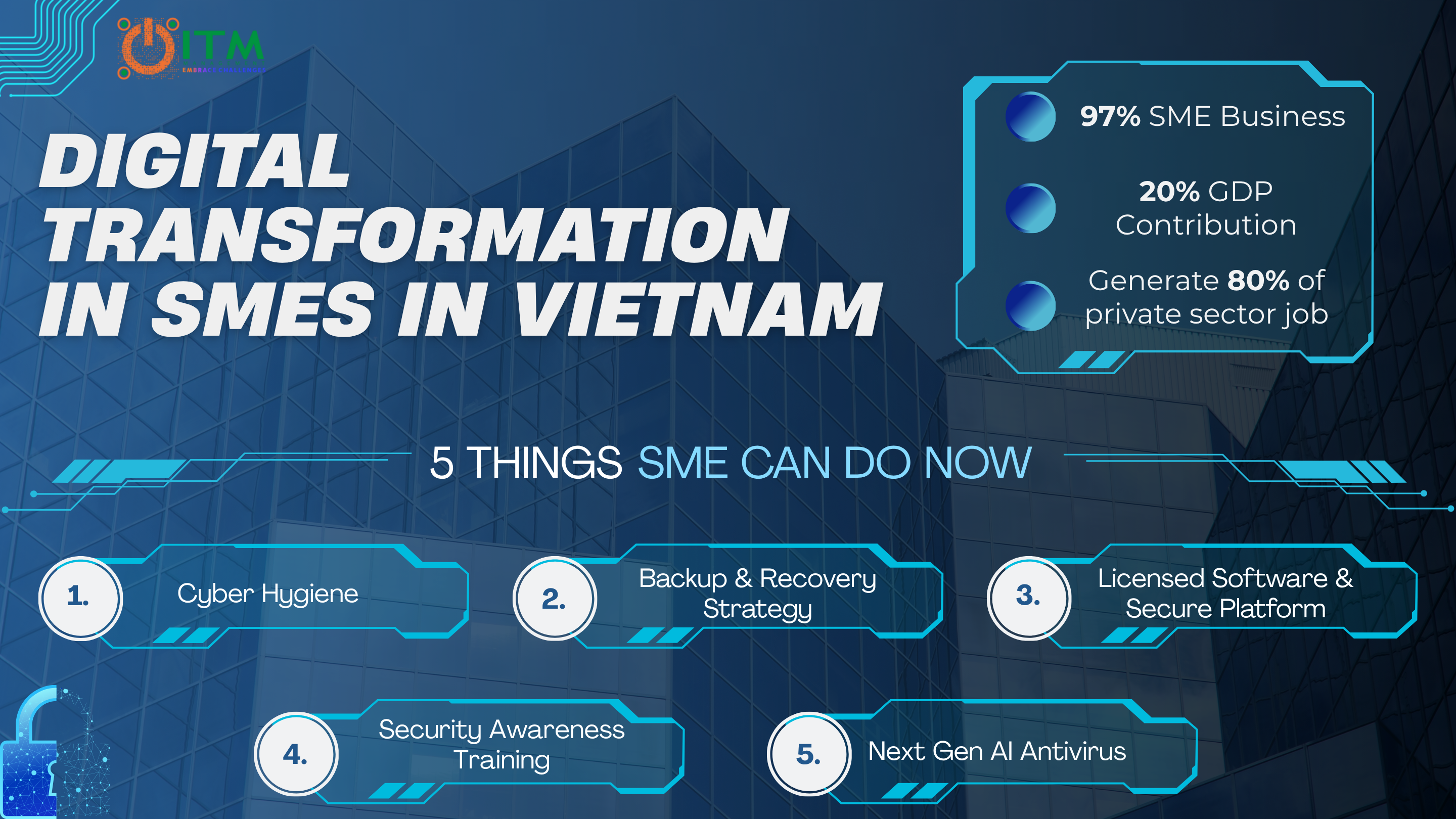
In Vietnam, SMEs account for approximately 97% of all businesses, contribute around 20% of GDP, and generate 80% of private sector jobs. They are dynamic, innovative, and increasingly digital.
However, their characteristics also make them attractive targets:
-
- High operational flexibility
- Rapid (often partial) digital transformation
- Heavy reliance on third-party platforms (social media, e-commerce, etc.)
These factors create opportunities for attackers, not because SMEs are inherently insecure, but because there are common gaps in how security is approached.
The Hidden Gaps That Make SMEs Vulnerable
In day-to-day operations, many SMEs face structural limitations that unintentionally expose them to cyber risks.
-
- With constrained budgets, businesses often prioritize cost-saving solutions, reduce upfront expenses.
- Use of low-cost or unlicensed software
- Lack of advanced protection tools
- Minimal investment in monitoring and response
In many organizations, roles are not clearly defined, and security responsibilities are not continuously monitored, reactive rather than proactive management. As a result, risks are often addressed only after an incident occurs.
Many SMEs do not have a clear response plan for cyber incidents. When an attack happens, the response tends to be reactive, uncoordinated, and time-consuming, leading to prolonged disruption and increased damage.
As businesses become more interconnected, SMEs can unintentionally act as entry points into larger systems. Without adequate security standards, they may become the weakest link, allowing attackers to move laterally into partner or enterprise environments.
Put simply, attackers do not need to target the biggest organization first. They only need one vulnerable entry point to expand their reach.
A common misconception is that adopting digital tools equals being “digitally ready.” Having business software, a website, or corporate email does not automatically mean being secure.
Many SMEs are still at a partial digitalization stage, relying heavily on third-party platforms without full control over their data or systems. This creates additional exposure, especially when platform policies, algorithms, or vulnerabilities change.
Meanwhile, cyber threats are becoming more visible and more sophisticated:
-
- Ransomware attacks are increasing
- Customer data is at greater risk of exposure
- Financial fraud schemes are becoming more advanced
Security investment should therefore be viewed not as an expense, but as a core component of sustainable business operations.
Why Do SMEs Often Invest Only After an Incident?
This pattern is common:
Before an attack: risks feel abstract → security is deprioritized
After an attack: consequences become clear → but response time is limited, costs increase, and decisions are made under pressure
Many SMEs remain vulnerable not because solutions are unavailable, but because action is delayed until it is too late.
What Should SMEs Do?
Instead of trying to eliminate all risks (which is unrealistic), businesses should focus on control and resilience – A Practical Cybersecurity Framework for SMEs
-
- Prevent – Reduce vulnerabilities with basic protection layers to minimize exposure before incidents occur
- Detect – Identify unusual activity early to gain visibility into abnormal behavior
- Respond — Contain and Mitigate to limit damage during an incident
- Recover — Restore Operations Quickly to ensure business continuity
- Forensics – Learn, Adapt, Strengthen to turn incidents into strategic improvement
Most importantly, cybersecurity should be treated as an ongoing process—not a one-time implementation.
Start with the Basics—Done Right
1. Cyber Hygiene: Simple but Critical
Basic security practices form the first line of defense:
-
- Use appropriate security software
- Keep systems and applications updated
- Enforce strong password policies and access control
These measures may seem simple, but when consistently applied, they significantly reduce vulnerabilities.
2. Backup with a Clear Recovery Strategy
Backup is not just about having copies of data—it is about ensuring recovery when needed.
Businesses should:
-
- Follow structured backup principles
- Regularly test restoration processes
- Keep backup data secure and separated
The goal is not storage—it is business continuity.
3. Use Licensed Software and Secure Platforms
-
- Moving to appropriate cloud platforms
- Using licensed software
- Following international security standards
- Adopting solutions suited to business scale
Even cost-effective tools can significantly reduce risk when implemented properly.
4. Build Awareness Across the Organization
Human factors remain one of the most common entry points for cyberattacks. Most attacks begin with everyday actions:
-
- Clicking on a phishing email
- Downloading unsafe files
- Using weak or shared passwords
Organizations should:
-
- Provide basic cybersecurity awareness training
- Help employees recognize risks in daily work
- Encourage secure usage habits
When employees are aware, they become the first and most important line of defense.
5. Adopt Modern Antivirus & Antimalware Solutions – Beyond Simple “Virus Scanning”
As cyber threats become increasingly sophisticated, traditional antivirus software is no longer sufficient to protect businesses.
Small and medium-sized enterprises (SMEs) need to transition to next-generation Antivirus and Antimalware solutions with advanced capabilities, including:
-
- Real-time behavioral analysis to detect unusual activities, even from previously unknown malware
- Continuous threat monitoring to identify early signs of intrusion
- Rapid incident response to minimize damage at the earliest stage
Another critical capability is device isolation. When an endpoint shows signs of compromise, the system can immediately isolate it from the internal network, preventing the threat from spreading to other systems.
This is particularly important for SMEs, where devices are often connected within a shared network without clear segmentation.
Investing in security solutions that can:
-
- Detect threats early
- Respond quickly
- Contain risks effectively
ITM: Supporting SMEs with a Practical Security Roadmap
For SMEs, cybersecurity does not need to start with complex systems. It should begin with a structured roadmap aligned with business needs and resources.
If your business aims to:
-
- Proactively reduce risks
- Establish clear incident response processes
- Minimize downtime and recover data efficiently
ITM can support tailored cybersecurity solutions, implemented step by step to ensure practicality and long-term effectiveness.
The goal is not to avoid attacks entirely. The goal is to ensure that when an incident occurs, your business remains operational and recovers quickly—with control.