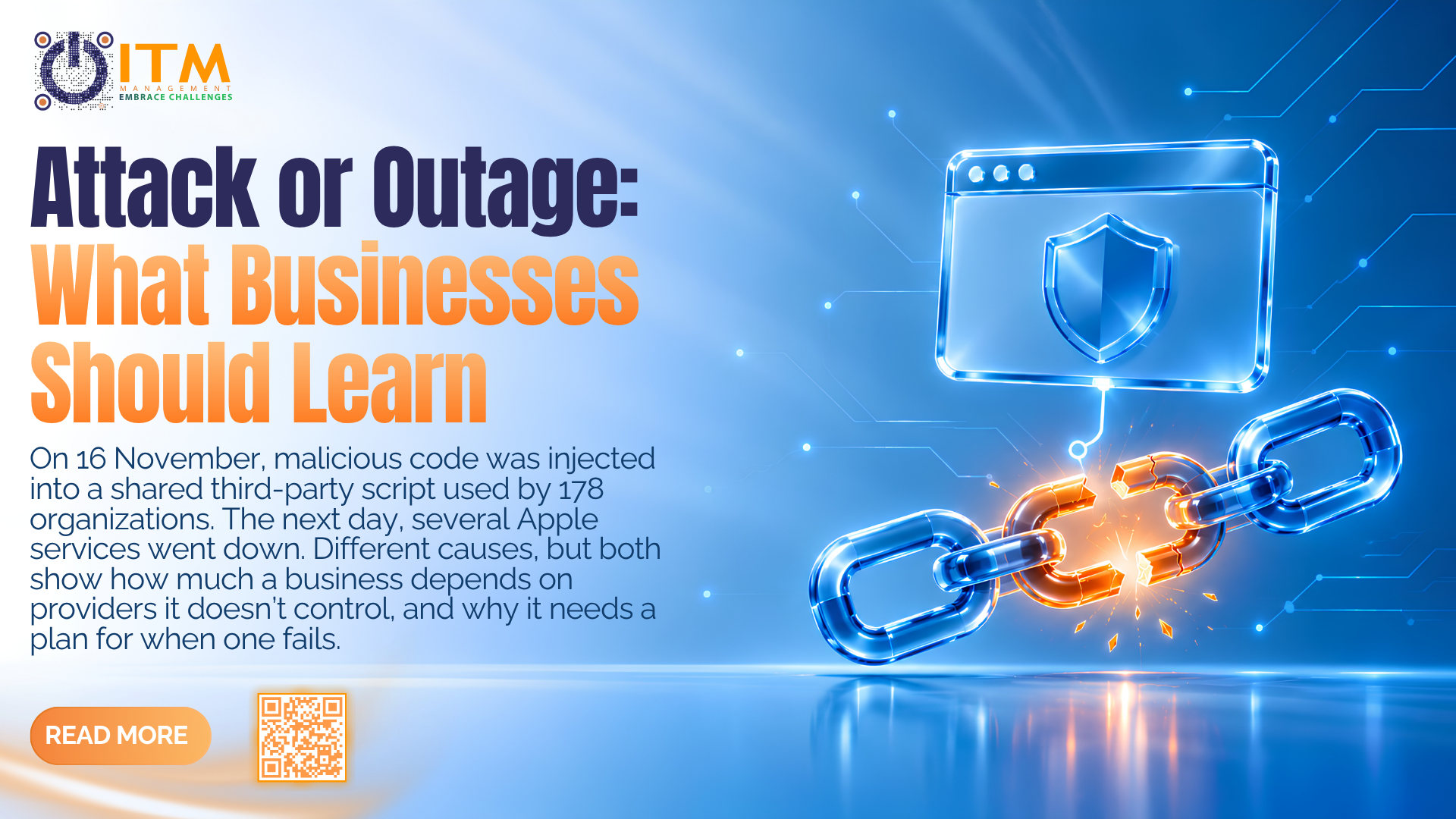

Within two days, two unrelated incidents showed how much modern businesses rely on providers they don’t control. One was a cyberattack on a shared piece of website code. The other was an outage of several well-known Apple services. The causes were different, but the lesson for any business is the same.
Incident one: A supply chain attack
On 16 November, researchers found malicious JavaScript in files belonging to Optimizely, a company that provides website testing and personalization software. Websites use this software by loading a small script from the provider.
That is what made the attack effective. The attackers didn’t need to break into each website one by one. By tampering with a shared third-party script, they could deliver malicious code to visitors through websites that were otherwise legitimate. This is known as a supply chain attack.
Researchers linked the affected files to 178 organizations, notable victims, in addition to Zoom and Salesforce, the incident affected a range of other prominent names, including CNN, the BBC, HSBC, IKEA, Equifax, GitLab, the cryptocurrency wallet provider Ledger, and the airline group Air France-KLM. Being on that list does not mean those organizations were breached themselves. The code came through a service they trusted.
According to the analysis, the injected code could redirect:
-
- Cryptocurrency theft. Automatically swapping the user’s intended cryptocurrency wallet address with the attacker’s address during transactions. Initial estimates indicate that the attackers managed to misappropriate approximately 7,000 USD in cryptocurrency before being stopped.
- Payment card skimming. Secretly capturing payment card details at the exact moment users entered them into their browsers.
- Session data theft. Collecting browser cookies and silently taking screenshots of the victims’ devices.
- Attacks on iOS devices. Deploying exploit toolkits (such as Coruna and DarkSword) to target and infect iPhones and iPads.
Optimizely has confirmed the incident, fixed the vulnerability and removed the injected code, and the monitored files were reported clean later the same day. Salesforce also announced that it proactively disabled the Optimizely code snippets and has initiated an internal investigation. No attacker has been publicly named.
Recommendations for users: Therefore, if you accessed the websites of Zoom, Salesforce, or any of the other aforementioned brands on November 16 and made a payment, you should check your bank account statements. Additionally, please update your iOS operating system to the latest version and clear up your browser cookies to ensure your security.
Incident two: an outage with no stated cause
On 17 November, several Apple services were disrupted, including iCloud account and sign-in, the App Store, AppleCare on Device and Apple Music. Users reported being asked to re-enter their Apple ID and password, and sign-ins to other services that use an Apple account failed. Some said they couldn’t activate new iPhones.
At the time of the reports, Apple had not stated the cause. Nothing links this outage to a cyberattack or to the Optimizely incident, so it should be treated as a separate event.
But the thing is: OpenAI’s AI model has identified 35 vulnerabilities in Apple products. According to a report by Forbes, a new AI security tool from OpenAI, dubbed “GPT-6 Cyber,” discovered approximately 35 security vulnerabilities of varying severity across the iPad, Apple Watch, Apple TV, and the Vision Pro headset.
Recommendations for users: The service outage this morning did not result in the exposure of user data. However, to protect against security vulnerabilities associated with the “OPTIMJACK” campaign, you should check for updates and upgrade your iPhone/iPad to iOS version 27.x (or, at a minimum, iOS 26.3 / iOS 18.7.3 or later).
What the two have in common
One was an attack and the other a service disruption, yet for the businesses and users affected the result was similar: something they rely on but don’t control stopped working or stopped being safe. That is the real lesson. The risk to your business includes the risk of every provider, platform and script it depends on.
This is a growing reality. Companies use cloud platforms, software-as-a-service tools, plugins, analytics and advertising scripts, payment services and employee devices. Each makes work easier, and each is also a dependency.
Why it’s easy to overlook
Most security attention goes to what a company directly owns: its network, its devices and its accounts. Third-party risk is harder to see. A script that has been on your website for years feels like part of it. A cloud service that works every day feels permanent. It is only when something fails that the dependency becomes visible.
You also usually can’t inspect a provider’s security yourself, and your customers will not distinguish between a problem on your site and a problem in a tool your site uses.
Five practical steps
List out and auditing all third-party providers, plugins, and scripts connected to the website and systems. Removing forgotten or outdated tools helps eliminate hidden entry points for attackers.
Every extra tool or script adds potential risk. Regularly reviews what is running on a platforms and enforces strict controls to block unauthorized code.
The reported exploits targeted vulnerable iPhones and iPads, a reminder that updates protect employees even when the problem starts elsewhere. Make sure staff devices get operating system updates promptly.
The reported exploits targeted vulnerable iPhones and iPads, a reminder that updates protect employees even when the problem starts elsewhere. Make sure staff devices get operating system updates promptly.
If you notice unexpected login prompts, strange account behavior, or anything unusual during payments, report it to the IT/Security team immediately. Early detection stops small issues from becoming major incidents. Monitoring helps you notice a problem early and respond before it spreads.
What you need to do today:
Please take two minutes to check if your phone, tablet, or laptop has any pending system updates and install them today.
How ITM can help
At ITM Management, we help companies understand and reduce the risks that come from their IT environment, including third-party exposure. This includes reviewing your infrastructure, strengthening device protection and monitoring, planning backup and recovery, and preparing your team to respond when something goes wrong.
-
- IT Audit & Dependency Mapping. Through our IT Audit & Consulting services, we review your digital environment, third-party integrations, and software assets to uncover forgotten tools, shadow IT, and hidden security gaps.
- Endpoint & Access Hardening. We deploy enterprise-grade security controls—including Multi-Factor Authentication (MFA), Access Management, Endpoint Detection & Response (EDR), and Data Loss Prevention (DLP)—to minimize your attack surface and block unauthorized scripts or activities
- Backup & Disaster Recovery (DR) Planning. We design and implement tailored Backup and Disaster Recovery architectures so your critical data stays safe and your team can keep working smoothly even when a major cloud provider goes down
- Managed Services, we take the burden off your internal team by ensuring company laptops, mobile devices, and systems receive timely OS and security updates
Incidents like these will keep happening, to large and small providers alike. You can’t prevent every one of them, but you can decide how prepared your business is when one occurs.
Contact our team to review where your business depends on others and how to prepare