
Artificial intelligence tools are becoming an important part of modern business operations. Staff across organizations use AI assistants to draft proposals, analyze data, generate code, summarize meetings, and even create internal documentation. However, as organizations increasingly rely on these platforms, an important question arises:
How secure is the information being shared with AI systems?
A recent incident involving Anthropic’s Claude AI platform highlighted the risks od misunderstanding how AI sharing features work. Reddit users first discovered that some Claude conversations and AI-generated ‘Artifacts’ shared through public links had become searchable through Google and other search engines, potentially exposing information that was never intended for public viewing.
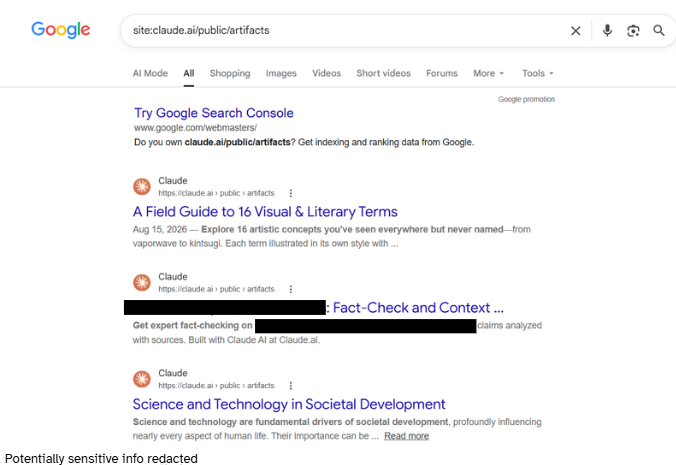
While the issue did not affect private conversations, it serves as a valuable lesson for businesses using AI tools daily in their operations.
What Happened?
Claude offers a feature that allows users to generate public links to conversations and Artifacts. These links are designed to make sharing information easier with colleagues, clients, or project stakeholders.
The problem arose when some of these publicly shared links became indexed by search engines, making them discoverable through search results. Users reported finding shared conversations, documents, spreadsheets, applications, and other AI-generated content through simple search queries.
Reports indicated that some exposed content included potentially sensitive information such as personal details, resumes, legal discussions, code snippets, and even credentials or keys that should never been publicly accessible.
Importantly, the issue primarily affected content that users had intentionally shared through public links. Private chats remained private. However, many users assumed that “sharing a link” meant the content was only accessible to the intended recipient rather than potentially discoverable across the internet.
Why This Matters for Businesses
The Claude incident is not simply a story about one AI platform. It highlights a broader challenge that affects virtually every organization adopting AI technologies. Many employees view AI tools as private workspaces. In reality, these platforms often include collaborations and sharing features that can introduce unexpected risks if not properly understood or managed.
Consider the types of information employees frequently enter into AI systems:
-
- Internal reports
- Customer information
- Business strategies
- Financial data
- Technical documentation
- Source code
- HR related information
- Contact drafts
If any of this content is accidentally shared through a public link, the consequences can range from embarrassment to serious security and compliance issues.
As AI adoption accelerates, organizations must recognize that data governance is no longer limited to email, cloud storage, and collaboration platforms. AI applications have become part of the corporate data ecosystem.
The Hidden Risk of “Anyone with the Link”
One of the most common misconceptions in digital collaborations is the belief that “Anyone with the link” means “only the people I send it to.”
In reality, public links are often to control once they leave the original user. They may be forwarded, reposted, indexed by search engines, or included in other publicly accessible content. Security experts have warned that link-based sharing provides convenience but not true privacy.
The Claude case demonstrated how easily this misunderstanding can lead to unintended exposure.
For businesses, this reinforces the importance of treating public links as public information unless additional access controls are in place. Furthermore, if these links are entered into AI tools or platforms, it is inevitable that hackers can access them.
AI Governance Is Becoming a Business Necessity
Many organizations have rushed to adopt AI tools without establishing clear policies regarding acceptable use, data classification, and information sharing.
A comprehensive AI governance strategy should address questions such as:
-
- What information can employees enter into AI systems?
- Which AI platforms are approved for business use?
- How should AI generated content be stored and shared?
- Who is responsible for monitoring AI related security risks?
- What controls exist to prevent accidental exposure of sensitive information?
Without clear guidance, employees often make their own decisions about AI usage, creating inconsistent practices across the organization.
The result is increased exposure to data leaks, compliance violations, and reputational damage.
Security Is Not Just a Technology Problem
Incidents like this often reveal that the biggest risk is not necessarily a technical vulnerability but a human misunderstanding.
Even when platforms provide warning or documentation, users may interpret sharing features differently than intended. This creates a gap between technical functionality and user expectations.
Businesses therefore need a combination of:
-
- Security controls
- Employee training
- Data governance policies
- Regular risk assessments
- Continuous monitoring
Technology alone cannot eliminate risk if users do not understand how information is being shared.
What Organizations Should Do Today
Whether your company uses Claude, ChatGPT, Microsoft Copilot, Gemini, or any other AI platform, several best practices can help reduce risk:
Ensure employees understand which sharing features are approved and when they should be used.
Establish clear guidelines on what data can and cannot be entered into AI systems.
Employees should understand the difference between private content, shared content, and publicly accessible content.
Review how AI tools are currently being used across departments and identify potential exposure risks.
Create processes to monitor AI adoption, manage access, and ensure compliance with company policies.
How ITM Can Help
The Claude search exposure is a reminder that AI adoption must be accompanied by strong governance, security, and operation oversight. While AI offers tremendous opportunities for productivity and innovation, businesses must ensure that convenience does not come at the cost of data security.
At ITM Management, we help organizations adopt new technologies safely and responsibly. From cybersecurity assessments to AI readiness strategies, our team works with businesses to build secure and scalable digital environments. With our Security Awareness Training and Gen AI Protection, we believe employees are the first line of defense against AI-related risks, and technology alone isn’t enough without the right training and control behind it.
As AI becomes increasingly integrated into everyday operations, having the right policies, controls, and security practices in place is no longer optional – it is essential.
Want to ensure your organization can leverage AI securely while protecting sensitive business information? Contact ITM Management to assess your current environment and strengthen your digital governance strategy.