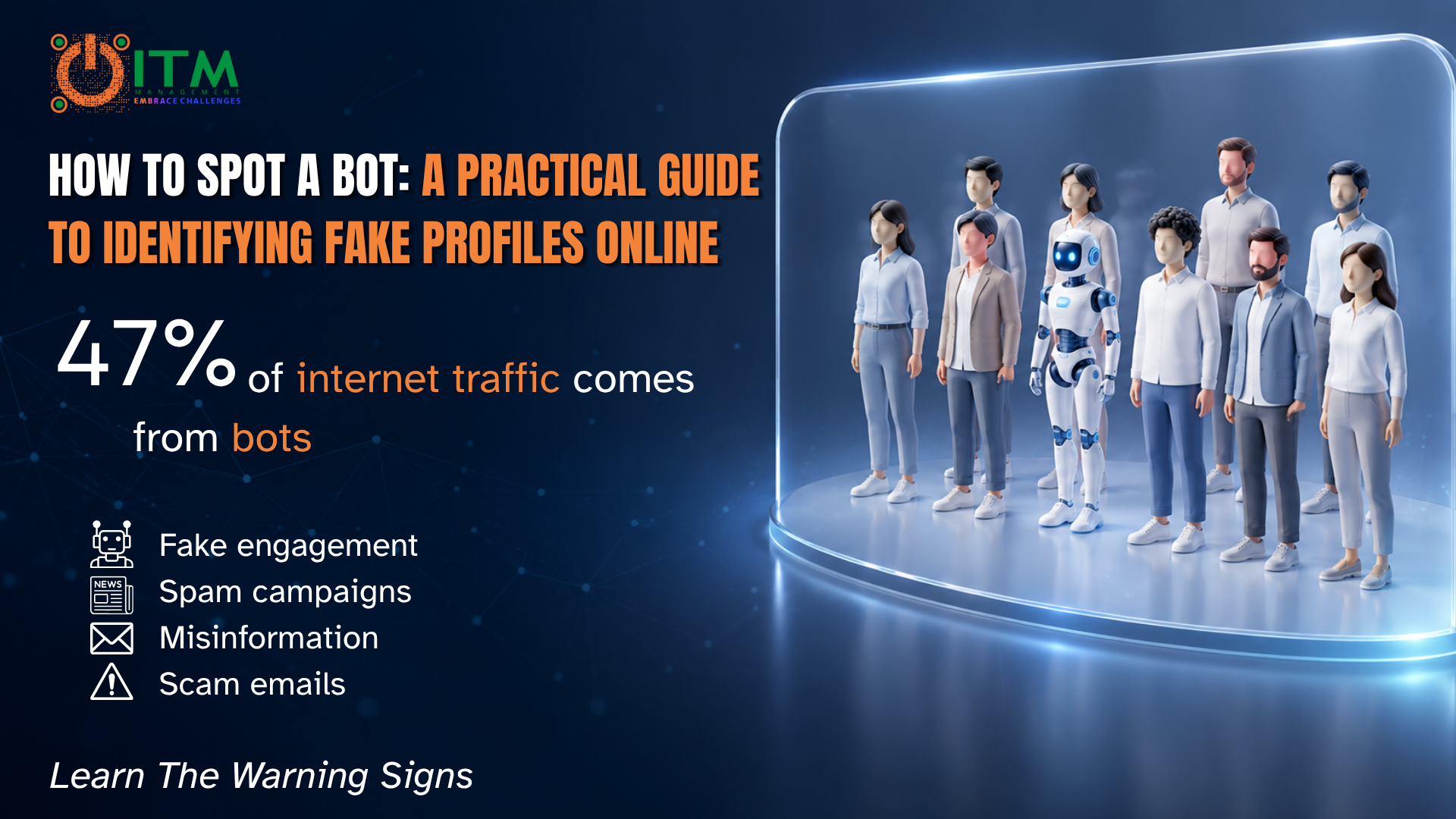

Fake profiles, bot-generated content, and automated phishing or spam campaigns have become a growing challenge across social media, email, and online platforms.
While bots can look and behave like real users, their purpose is often far from harmless. Some are designed to influence conversations, while others are used to distribute phishing emails, fraudulent messages, malicious links, or spam at scale.
And the impact isn’t limited to companies or businesses. Individuals can be targeted too.
A fake profile may pretend to be someone you know, a recruiter, a customer, or even a friend. A seemingly harmless message can be used to build trust before asking for personal information, money, credentials, or access to an account.
The same principle applies in the workplace. A single compromised personal account can become an entry point into a company environment, especially when employees use the same credentials across multiple services or share information through email, messaging apps, and cloud platforms.
Why Spotting Bots Matters
Bots are increasingly used to amplify misleading content, manipulate conversations, and create artificial engagement. Because they are designed to mimic human behavior, identifying them is not always straightforward.
Bots are not used solely to generate fake social media engagement; in the realm of cybersecurity, they are increasingly employed to automate the initial stages of an attack.
Attackers can use bots to:
-
- Send mass phishing emails and spam
- Create fake accounts to reach potential victims
- Impersonate colleagues, clients, or trusted brands
- Distribute malicious links or attachments
- Gather information from public accounts
- Generate deceptive messages using AI
- Automatically interact with victims to build trust
A concerning aspect is that these attacks do not necessarily begin with an obviously fraudulent email.
An email might feature a company logo, a professional signature, and naturally written content. A message could originate from an account that looks identical to that of an acquaintance. A request might appear perfectly legitimate, such as:
-
- “Please confirm your account details.”
- “Could you open this file for me?”
- “Your account requires verification.”
- “Please log in to prevent your account from being locked.”
A single click on a malicious link can lead to a fake login page, resulting in the theft of credentials or the download of malware.
Therefore, recognizing signs of irregularity before engaging is one of the most critical layers of defense.
What Is a Bot and How Does It Operate Online?
A bot is an automated or semi-automated account that performs actions such as posting content, liking posts, or leaving comments without genuine human intent. These accounts often operate at scale and can appear highly active.
Bots may be used to:
-
- Repost content repeatedly
- Generate large volumes of comments or replies
- Influence opinions or trends artificially
- Send phishing or spam emails at scale
- Impersonate businesses, colleagues, or trusted brands
- Distribute malicious links or attachments
- Generate AI-written scam messages
While some bots serve legitimate purposes, malicious bots are designed to mislead, manipulate, or disrupt.
10 Key Signs to Help You Identify a Bot Behaviour
Important: Any single sign on its own may simply be a coincidence. To make an accurate assessment, users should look for multiple signs together before deciding whether an account is a bot.
1. Unusual Emails or Messages
Bots are increasingly used to send large volumes of phishing and spam emails.
Common warning signs include:
-
- Urgent requests requiring immediate action
- Suspicious links or attachments
- Unexpected password reset or login notifications
- Messages claiming to be from banks, suppliers, delivery companies, or internal colleagues
- Generic greetings instead of personalized communication
Even if a message appears professional, users should verify the sender before clicking links or sharing information.
2. Messages That Feel Human but Seem Too Perfect
Advances in AI allow bots to generate convincing messages with proper grammar and natural language.
Warning signs include:
-
- Messages that avoid specific details
- Replies that seem scripted or repetitive
- Conversations that quickly redirect users toward links, downloads, or requests for information
- Communication that feels unusually generic despite appearing personalized
Modern bots are becoming harder to detect because they increasingly resemble real human communication.
3. When Was the Profile Created?
Some social media platforms display the account creation date. If a profile was created very recently but already shows high activity, this may be a red flag. New accounts with aggressive posting behavior often warrant closer inspection.
4. How Often Does the Profile Post?
Bots tend to post in unnatural patterns, such as:
-
- An unusually high number of posts per day
- Posting at the same exact times every day
- Posting continuously, day and night
This level of consistency is difficult for real users to maintain.
5. Does the Content Seem “Off”?
Bot-generated content often feels unnatural or repetitive. Common signs include:
-
- Reposting the exact same content within short periods
- Sharing inflammatory memes or GIFs
- Using strange or awkward phrasing
- Consistently directing users to a specific link or action
Exercise particular caution if a conversation repeatedly steers you toward a link, a downloadable file, login credentials, or a request for data.
6. Does the Profile Lack Personal Flair?
Bots rarely share personal photos, experiences, or genuine updates. Instead, they typically repost a specific type of content repeatedly. A complete absence of personal context is a strong indicator of automation.
7. Are There Too Many Stock Images?
Many bot accounts rely heavily on stock photos. Warning signs include:
-
- Profile pictures that appear to be stock images
- Images that do not match the context of the written content
Reverse image searches can help verify whether images are widely reused elsewhere.
8. Low Follower Count with High Following
Bot profiles often have:
-
- Very few followers
- A large number of accounts they follow
This imbalance is a common tactic used to appear legitimate while spreading content widely.
9. Odd or Random Usernames
Usernames that include random letters or numbers such as oddname_35623 are frequently associated with bot accounts.
While not definitive on their own, such naming patterns are worth noting alongside other signs.
10. Auto Replies and Generic Comments
Bots can generate quick, generic, or unrelated replies shortly after a post is published. If you notice comments that don’t align with the topic or appear instantly, Repeatedly directs users to a specific website or link. Take a closer look.
A Critical Reminder: Don’t Rely on One Sign Alone
Any one of these behaviors may occur naturally from time to time. However, when several signs appear together, the likelihood that an account is a bot increases significantly.
Careful observation and critical thinking are essential when navigating online interactions.
Key Takeaway
Bots, fake profiles, phishing emails, and automated scam campaigns are an increasingly common part of the digital landscape.
Whether they appear on social media, through email, or in direct messages, the goal is often the same: to influence, deceive, or exploit users
Knowing how to spot them empowers users to:
-
- Avoid engaging with fake accounts
- Reduce the spread of disinformation
- Interact more safely and responsibly online
- Protect personal and business information
- Recognize potential phishing and social engineering attempts
Stay Alert. Pause. Verify.
-
- Someone suddenly pretending to know you?
Take a moment to verify who they are. - An urgent request asking you to act immediately?
Pause before clicking, replying, or transferring anything. - A profile with very little history, unusual activity, or repetitive content?
Look a little closer. - A message containing unexpected links, attachments, or requests for sensitive information?
Don’t assume it is safe just because the sender appears familiar.
- Someone suddenly pretending to know you?
The goal isn’t to distrust every person or message online. It’s to develop the habit of pausing, checking, and verifying before acting.
Protect Your Organization with Strong Cyber Awareness
Online threats don’t stop at bots. Phishing emails, spam campaigns, social engineering attacks, and AI-generated scams continue to create significant cybersecurity risks for businesses. Disinformation, social engineering, and human error remain major cybersecurity risks for businesses.
ITM helps organizations strengthen their cyber awareness and security posture through practical, proactive IT services.
From awareness training to comprehensive IT preparedness, our experts help you identify risks, close security gaps, and build a more resilient digital environment.
-
- Improve cyber awareness across your organization
- Reduce human-driven security risks
- Strengthen your overall IT security foundation
Talk to ITM today to learn how our cybersecurity and IT preparedness services can help protect your business in an increasingly digital world.