
Cyber threats are no longer limited to large enterprises. Today, small and medium-sized businesses (SMBs) are among the most frequently targeted organizations often because their security environments rely on fragmented tools, limited automation, and outdated assumptions about backup and recovery.
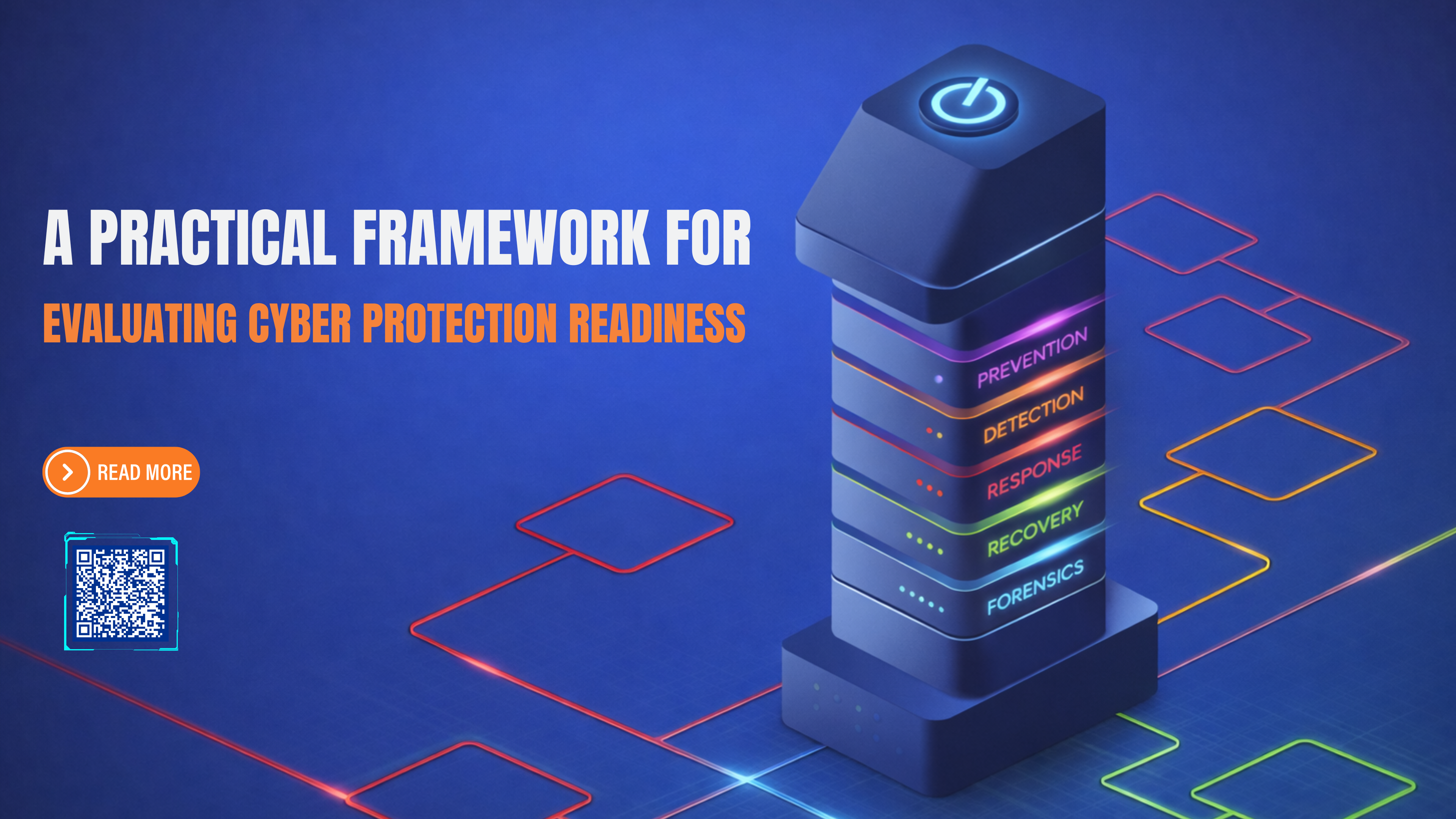
This article introduces a practical framework for evaluating cyber protection readiness, designed to help SMBs understand whether their current security approach can truly withstand modern threats. Rather than focusing on individual technologies, the framework emphasizes capabilities, integration, and operational readiness across the full cyber protection lifecycle.
Why a Framework-Based Approach Matters
Many organizations believe they are secure because antivirus software, backups, or firewalls are already in place. In reality, modern cyberattacks exploit the gaps between these tools.
This framework is not intended to function as a technical audit. Instead, it helps business and IT leaders challenge assumptions, identify blind spots, and determine whether their security environment operates as a cohesive system or merely as a collection of isolated components.
Prevention focuses on minimizing vulnerabilities across systems, users, and applications before attackers can exploit them.
Core preventive capabilities typically include:
-
- Regular vulnerability assessments
- Consistent and controlled patch management
- Data loss prevention (DLP) for sensitive information
- Ongoing security awareness training
- Protection and hardening of collaboration and remote-work tools
Strong prevention is often invisible when it works. Its value becomes apparent only when incidents never materialize or are quietly avoided.
In many environments, backups are treated purely as a safety net. Less attention is given to whether those backups are continuously validated and protected from hidden risks.
Reflection point: Are your backups treated as active security assets or simply as storage? Are your backups regularly validated and protected from compromise?
No preventive strategy is flawless. When threats bypass defenses, early detection determines whether an incident remains contained or escalates into a broader disruption.
Effective detection capabilities often include:
-
- AI- and behavior-based anti-malware protection
- Anti-phishing controls for email and user identities
- URL filtering to block malicious or compromised websites
- Detection based on known indicators of compromise (IoCs)
- Endpoint Detection and Response (EDR) for continuous monitoring
Detection is not only about identifying suspicious activity it is about recognizing it early enough to maintain control. Organizations with mature detection practices rely on trusted reference points, such as verified backups, to distinguish normal behavior from malicious activity and reduce response delays.
Reflection:
Does your environment clearly understand what “normal” looks like?
Once a threat is detected, speed and coordination become critical. A resilient response capability typically includes:
-
- Blocking malicious file and script execution, including fileless attacks
- Isolating compromised devices to prevent lateral movement
- Clearly defined incident response procedures
- Real-time alerts and notifications
- Centralized visibility across network activity and endpoints
During an active incident, dashboards alone do not stop attacks. Environments that depend heavily on manual decision-making often lose valuable time while teams determine next steps.
More resilient setups allow alerts to trigger predefined actions automatically, limiting damage before human intervention is required.
Reflection point: When a threat is detected, does your security stack merely notify or does it immediately act?
Recovery is often viewed as the final step. In practice, it represents a critical turning point either to stabilize operations or to repeat the same failure.
Key recovery capabilities include:
-
- Scanning backups for malware before restoration
- Rapid or near-instant recovery to minimize downtime
- Safe recovery processes that apply the latest patches and updates
- Automated recovery workflows to reduce manual errors
- Email archiving and recovery for business continuity
Restoring systems quickly is important. Restoring them from verified, trusted data is essential to avoid reintroducing dormant threats.
Reflection point: If you had to restore critical systems today, how confident are you that the data you rely on is genuinely clean?
Cyber protection does not end with recovery. Long-term resilience depends on understanding how an incident occurred and how to prevent it from happening again.
Forensic readiness often includes:
-
- Full data backups captured in an unaltered, forensically sound state
- Memory snapshots that preserve system and process activity
- Root cause analysis to identify attack vectors and infection paths
Without forensic insight, organizations risk addressing symptoms rather than causes—leaving them exposed to repeat incidents.
Reflection point: After an incident, could your organization confidently explain what happened and why?
Cyber Protection Readiness Snapshot
Taken together, the reflection points throughout this article form a practical snapshot of cyber protection readiness. They are not designed to produce simple yes-or-no answers. Instead, they highlight whether an organization operates with:
-
- Disconnected tools and manual processes, or
- An integrated, automated cyber protection framework
Uncertainty in any area often signals exposure not because technology is missing, but because systems are not working together as intended.
Turning Cyber Protection Insight into Action
Understanding where cyber protection stands is the foundation of every sound security decision. What matters next is gaining a clear view of risk, priorities, and the practical steps needed to strengthen resilience.
ITM works alongside organizations to evaluate cyber protection readiness, uncover hidden gaps, and translate complexity into a clear, executable improvement plan aligned with real operational needs.
Start with a focused cyber protection assessment and move forward with clarity, not assumptions.